I’m absurdly proud of having predicted Trump as President, more than two months before the Republican convention, and six months before the general election. I know of only two earlier public predictions, by a professional pollster two months before me and a cartoonist extraordinaire more than eight months before me. Ah, but pride goeth before a fall, so let me jump off that cliff now, by making my prediction eighteen months before Election Day: Elizabeth Warren will win in a landslide. (btw, if you’re going to comment now or later on why I’m wrong, do me a favor and include the link where you called the results of the 2016 election beforehand. Oh, you have no public record of that? Then shush, you.)
The Democratic nomination will come down to Sanders or Warren. But first, let me give the two-sentence dismissal of all the other nominees:
Biden: He’s the last bastion of the Democratic establishment. But the machine is crumbling, and he has too much history to overcome.
Buttigieg: He’s the flavor du jour, but lacks substance. Personality can win against substance, as we’ve seen time and time again, but his personality isn’t actually strong enough.
Booker: America isn’t ready for its second black President. And if it were, Booker’s “love” campaign isn’t the right tenor this cycle.
Harris: A black woman president is two bridges too far for most of this country. And she’s hindered by her record as a prosecutor.
O’Rourke: Beto has already flamed out. If you’re running the Kennedy playbook, you need to actually be a Kennedy.
Castro, Delaney, Gabbard, Gillibrand, Hickenlooper, Inslee, Klobuchar, Messam, Moulton, Ryan, Swalwell, Williamson, Yang: No. Too far behind, nothing distinctive enough for them to catch up.
Let me be clear: I don’t want any of the above to be true. I’m just saying I think it is true, and mere wishes otherwise aren’t going to win this horserace.
Sanders and Warren might seem similar. They’re both old, white, and progressive. But they have one starkly obvious difference – no, not that one is a man and the other is a woman – one is a socialist and the other is a capitalist.
Sanders is a democratic socialist, and proud of that label – and deserving of both the label and the pride. A lot of the country has come around to positions that he has been espousing for his entire professional life. Warren wouldn’t label herself this way, but she’s a democratic capitalist – she believes in market mechanisms to address many social problems, but believes the market must be firmly guided by the best interests of a democracy.
At the end of the day, as much recent fervor as there’s been for socialist policies, this country isn’t going to elect an avowed socialist as president, at least not yet. Warren’s policies and her effectiveness in getting them into the discussion will win both the media and the electorate to her side. She won’t be hindered like Hillary was by either her past or by forces she doesn’t control. The distortions of the prior Presidential election can be summarized as: sexism and Russia. Both will continue to have an effect, but that effect will be much smaller than the prior election, due to countervailing forces that have arisen in the meantime.
Once Warren wins the Democratic nomination, she’ll crush Trump in a landslide. I’ll go over the rationale for this … in about eleven months. By Super Tuesday, if this post has any legs, it’ll be worth writing the follow up. And if it’s wrong, well, pride is a sin anyway; I shall repent.
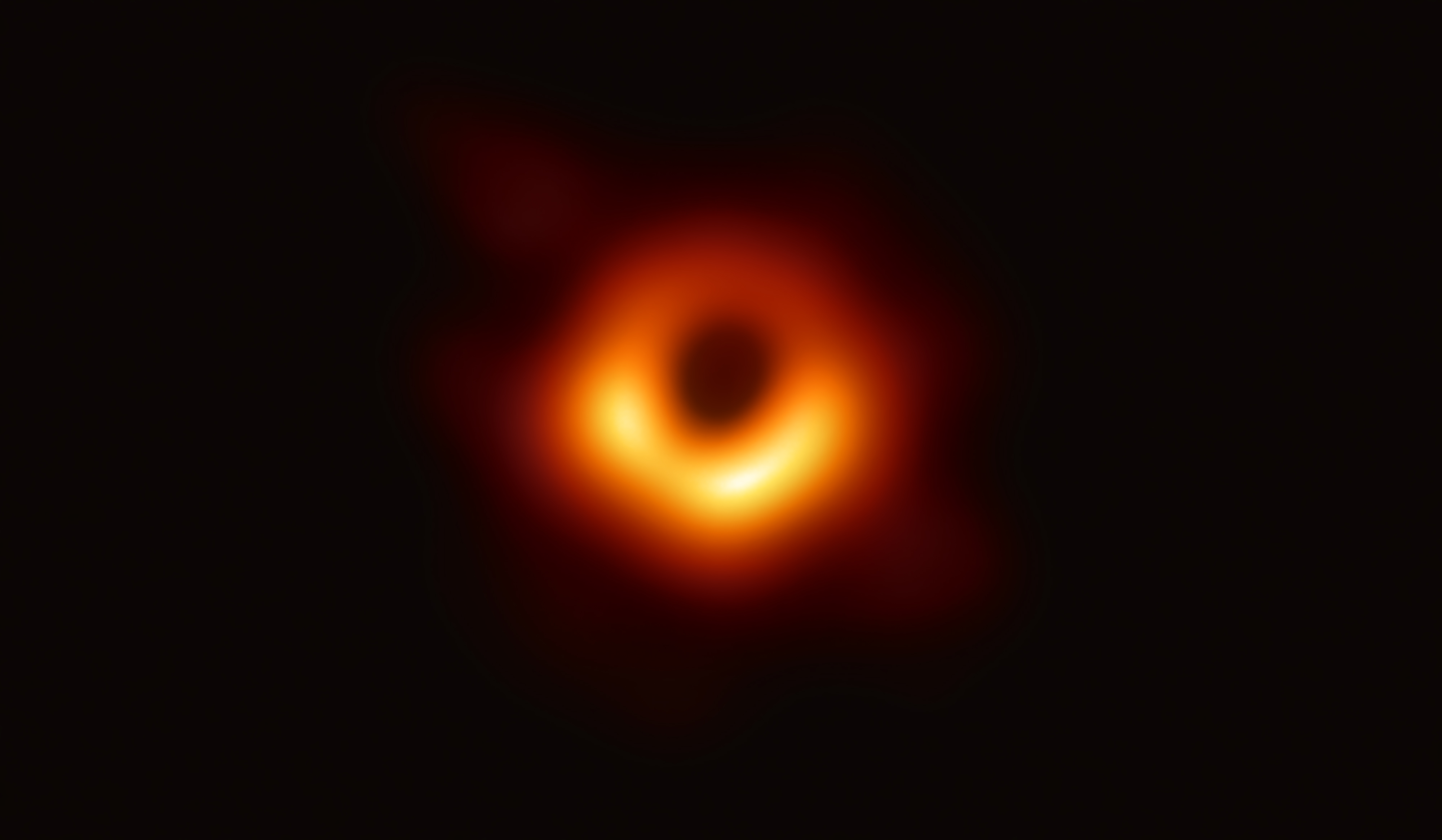
This week’s first-ever picture of a black hole was captured by the Event Horizon Telescope, which is named after the critical boundary around the black hole. Once an object crosses the event horizon into the black hole, it will never be seen again by any observer on this side of the horizon.
The pictured black hole is fifty-five million years away, and that’s only by traveling at the speed of light. We seem to be much closer to another border beyond which there is no return, one that deserves the melodramatic name of The Apocalypse Horizon.
The world will end someday. There is no serious dispute about this fact, only a question of when. And that question seems unimportant for nearly all of us, as the end is at least several billions of years away. The Sun will expand until it engulfs the Earth, consuming whatever is left on the planet in a giant mass of red fire. No student of the universe disagrees with this, other than the few who believe that the end is even further away, with the Earth remaining just outside of the swelling Sun, surviving only to eventually collide with the Moon and then spin out to a cold death in the infinite cosmos. If that happens, it would be about a billion billion years from now. Those aren’t the only two stories: there are a few radicals who believe that instead of spinning away into the infinite, the dead husk of the Earth would eventually collapse back into the cold remnants of the dying Sun, which would take about a hundred times longer than a billion billion years.
No one can really fathom that amount of time, none of us have to worry about that end. So the fact that the world will end isn’t particularly compelling – but our lack of interest is only partially because the distant outcomes are so far beyond our capacity to envision. The disinterest is really driven by over-repetition: we’ve lived with stories of the end for about as long as we’ve had stories. There is always someone raving about the end of the world.
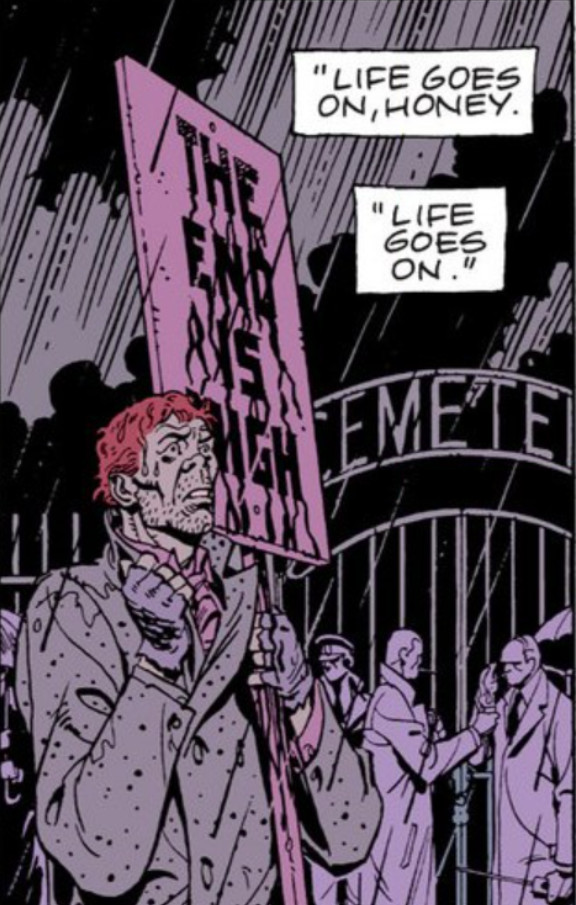
As a child I saw the modern ur-form of this storyteller with my own eyes, the lunatic in Times Square, disheveled in a stained trench coat and torn denim jeans, holding high a hand-lettered sign with the classic message: “THE END IS NIGH.” Even as a child I knew that he had nothing interesting to say about the end of the world. Urgency is always combined with a call to action, but the message is really about the desired action, and the story of urgency is provided only to give reason to take the action immediately. “REPENT!” The meaning and path to salvation was the story this prophet really wanted to tell; the cries of apocalypse were just a ploy to get anyone to listen.
What was the first story ever told – and why was it told? This must have been at least tens of thousands of years ago, around the time we first became capable of abstract thought. Some of those first stories must have been about food or shelter or sex. But I feel certain that on the day after the first person looked up into the sun and recalled that the sun also rose yesterday, there was some other person there to tell a story about why there would be no sun tomorrow nor any day afterwards. And that storyteller was telling the apocalyptic story to get the audience to do something. The story of the end was never really about the end, but about what the storyteller wants the audience to do now.
That is how it has been throughout all of human history, and that is why the savvy listener disregards apocalyptic tales today. The end isn’t coming unless it’s the one that’s too far away to matter. That’s the way it has always been. Anyone who tells you any different wants something from you.
But that will only be true until the day that it isn’t. The inevitable end of the Earth may be in the unreachable cosmological distance, and all of the old stories may have been diversions – but we now live in an age where humans have planetary impact of a scale that inarguably includes the ability to end all of humanity. In the simplest apocalyptic story of our times, the collective nuclear arsenal we’ve built is more than sufficient to make the planet uninhabitable. That wouldn’t be the end of all life, and the planet itself would continue on its many-billion year journey without us, but the end of humanity deserves a name, and the best one we have is Apocalypse. The term may be dramatic and it may be stained by thousands of years of misuse, but we have no better word for describing not the end of the planet, but the event that ends our time on it.
I don’t ask you to believe in any particular form of the Apocalypse. There are plentiful stories for whatever belief system you ascribe to – you can pick and choose among nuclear holocaust, environmental collapse, killer robots, infectious superbugs, or even good old fashioned Wrath of God. The point is that for the first time in human history, some of these apocalyptic stories might actually be true. And although most of the people telling you these stories probably want you to do something in reaction, unlike all previous times, the real story isn’t the desired action, but is actually the question of whether or not this particular story of the end is a true story.
All of the stories with a scientific basis have a point of no return well before the actual end, even though that point may be impossible to identify with current science. There is a point at which fissile material and nuclear technology will be so broadly available that avoiding disaster becomes improbable. There is a point at which the oceans will rise so high that areas now populated by millions will be underwater. There is a point at which the intelligence of machines will allow them to create more intelligent machines. Once those points are past, there is no going back. Those points of no return form our modern Apocalypse Horizon: the point past which we cannot prevent the end of all of our stories.
If you believe in science, you must believe that we will eventually cross the Apocalypse Horizon, and it’s possible that we have already done so. In our modern apocalyptic stories, the time between the point of no return and the storied end is about three generations. This span of parent to child to grandchild is crucial: If we are near the horizon, that means that people who are in their reproductive years today can feel confident that they and their children can live a long life before the Apocalypse occurs – but they’ll have to tell their children that their grandchildren are not likely to live out their natural lives. Or they’ll need to make up stories that are the opposite in substance but similar in purpose to the apocalyptic tales of the past: falsehoods designed to lull a doomed generation into acceptance of their unchangeable fate.
Are we the generation that lives just prior to crossing the Apocalypse Horizon? Even the possibility means that people with children in their lives might think differently than any generation before about how to discuss the future. All prior generations could simply ignore the stories of the end, as it had always been rational to do so in the past. All future generations will be past the point of no return, so will be beyond the point where choices about future generations matter. Only the generation that crosses the Apocalypse Horizon really has a decision to make about what to tell their children.
This is no entreaty to repent, I have no story of salvation to sell. This week we saw something that has never been seen before in human history, though it existed fifty-five million years ago; it is an apt time to reflect on our existence in the universe. The stories that have never been true before must now be taken seriously, for ignoring them no longer serves the truth, but furthers a lie. The Apocalypse Horizon is near enough to see, and in a sense it hardly makes any difference whether it is just in front of us or just behind us.

 ginsudo