who’s the boss?

lemme ‘splain something to ya: You’re probably payin too much for your mobile phone.

In case you’re thinking: No shit sherlock . . . .

I don’t mean you’re paying too much for your phone. I mean, you’re giving “Apple Computer, Inc.” too much of your value no matter how much money you pay. Or would be, if they still had that name. They don’t have that name anymore, because they don’t need it, because they are renting space in your head for free.

I don’t have time for this bullshit, bc I’m DOing IT.

Daily writing prompt
Describe the most ambitious DIY project you’ve ever taken on.

July 4, 1976

Scotch Plains, New Jersey, was the perfect American town. I’m sure that some of you feel that you grew up in the best small town in America, and if you’re lucky enough to feel that way, I’m not trying to tell you that you’re wrong. I’m just saying, I feel the same way.

Obviously, I’m reminiscing here rather than convincing. But especially when I think about growing up, I talk and often think like a guy from Jersey, so maybe some of this will sound like an argument. Or maybe I can say, Cali-style where I live now, that I’m just stating my personal inner truth: The 1970s were the perfect time to grow up in America, because it was then that you had the best chance of realizing the American dream.

A hundred years after the Emancipation Proclamation, just past the transformative Civil Rights Era, heading into decades of American peace and domination. If you were an American child in the Seventies, came of age in the Eighties, started your career in the Nineties, boomed with the internet in the Aughts – you at least had a chance of a rising tide lifting your boat, if you were lucky enough to be born in the right place at the right time. I don’t care what kind of crappy boat we’re talking about here: Even your little dinghy, rusty and full of holes, tattered sail and busted motor and all, even that sad water jalopy could take you somewhere worth the time at sea.

Just 25 miles from New York City, Scotch Plains was a perfect suburban repository of the immigration influx of the late 19th Century that came through Ellis Island. The first couple of generations clawed out a new life on the Lower East Side of Manhattan. By the third generation, people who cared more about assimilating went to Long Island or, as a reach, to Connecticut. But if you embraced your ethnic roots, you went to New Jersey. So to me, Scotch Plains, NJ was the perfect melting pot, a stew of Irish Catholics, Italians, Jews and Poles, Blacks and Puerto Ricans, and a few Orientals. (The term “Asian American” wasn’t a thing back then.) Everyone could be proud of who we were, but everyone still had to figure out how to live together despite how different we were.

No one in my town knew what Korea was, not really, including me. But by six years old, I could not avoid an education on what America was, or wanted to be. All of us in town that age learned our first five-syllable word: Bicentennial. In July, it would be the 200th anniversary of the Declaration of Independence. I remember how hot it was that summer, but at least it was sandwiched between the two oil crises of that decade, and we could afford to run air conditioning in our split level ranch through the worst of the sweltering summer.

The red, white, and blue was everywhere leading up to that July. Bunting draped all over the downtown main streets, flags flapping from every other house, men with lapel pins and women with ribbons of old glory. A six year old can’t distinguish between genuine pride and community conformity, but the unavoidable displays of patriotism worked on my malleable little mind. I didn’t have to wonder whether America was exceptional, I knew it must be true because everyone in town was telling me so.

And I said it to my father, while taking refuge one brutally humid afternoon of the summer of 1976, sitting in my parents bedroom, the window air conditioner barely able to keep up with the modest demands of the little room. I sat on the bed while my father puttered around the dressing table, and I asked him: Isn’t it great? Isn’t it great that we live here, in the strongest, proudest, best country in the history of all the world? Isn’t it amazing what we’ve achieved in 200 years?

He said:

Well, it’s a good start, maybe.

I couldn’t believe my ears. What did this fresh of the boat Korean know about the Great United States of America?

He answered as best as he could. I’m not gonna pretend that I remember his explanation word for word; he spoke for a long time that afternoon. He spoke in broken English and never used memorable words. But I remember everything. Because he communicated all of his meaning and his intent through his broken language, through his pauses, elisions and silences, and through his face and his body. I remember exactly what he communicated to me, not word for word, but in his full meaning, in his intent, and in his insistence on the lesson:

Yeah, it’s a good start. The people you now call “Korean” have a four thousand year history. And that recently included two consecutive 500-year dynasties. It’s always the same pattern: around half a century of figuring out how the nation works, a century or so of rising to the good times, maybe a century of actual great times, and then a troubled period of decades where the infighting allows the outside in to destroy your nation. But it’s a long slow decline, could be another century or two. The first of those 500-year Korean dynasties ended in dominance by the Mongols, the second in dominance by Japan. In both cases, the same pattern.

Roughly: 50 years of construction, 100 years of rise, 100 years of good times, 50 years of infighting, and then 200 years to the end. In each period, give or take a few decades.

I thought the old man was batty. In the 1970’s in Scotch Plains, New Jersey, nobody knew anything about Korea, not really, not like my father did. But he didn’t have a clue about America. Surely this fresh off the boat Korean knew nothing about the future of my birthland, the United States of America.

Well …

That was coming on fifty years ago, I’m over a decade older now than my father was that summer afternoon, I’ve lived a whole lotta life and I’ve seen some things. I’ve even absorbed a little history, something I shoulda soaked up more from the pride of my paisanos back in Jersey: Rome had a 500 year Republic followed by a 500 year Empire. And both followed the pattern. If you know only last century’s history, the phrase “a thousand year dynasty” might sound a little chilling to you. But that was only recent history. In the really long run, perhaps it’s not so terrible to imagine two consecutive 500 year dynasties. There is a thousand years of glory in such a history even existing, no matter the ups and downs.

The 250th anniversary of July 4, 1976 is within our sight, as is the current state of our nation, laid bare for anyone to interpret. I leave the details of math and pattern matching as an exercise for the reader and for X. Just a closing thought: I think people these days worry a lot about American decline. But nobody gets good times forever. You can have good times and bad times and still last a long time; rise and fall and recovery and try again. It’s not easy. It doesn’t happen a lot of times in history. But it does happen, in the exceptional cases.

corporate valar

“Valar Morghulis” means “All Men Must Die” in High Valerian. Valerian is not a real language, it’s from the fictional world of Game of Thrones – but perhaps the phrase is now better known than its original Latin counterpart, “Memento Mori.” Remember Death – the sentiment is the same: we are all mortal, and reflecting on this truth helps us live better in our short time of existence.

The death of Susan Wojcicki stands as yet another reminder of this eternal truth, as if we needed another. She is the fifth close working colleague of mine to die during my career, though I cannot claim to have been truly close to her. I was perhaps the shortest tenured member of her various teams, having lasted only six months before she decided, quite correctly, that I was not a good fit for her as a direct report. I was never a good fit for Google, despite lasting there for five years, and it was a kindness for her to allow me to simply keep the same responsibilities with another boss.

So this post is not about Susan, because the many who knew her better are already posting in great volume about her kindness, her humanity, her towering achievements. My passing familiarity with her is really meaningless in comparison.

Instead, here I would like to reflect on how “Valar Morghulis” might inform the life of a company. Perhaps this seems absurd, or even inhuman, as corporations aren’t people, regardless of some bizarre legal interpretations of corporate personhood. But it’s undeniable that great corporations affect a great many human lives, and sometimes do so for longer than the lifespan of any one human life. And yet, just as with every human, all corporations must die.

I’ll indulge in just one vignette from my time working with Susan. This was early in my time at Google, after I’d spent a dozen years in the startup trenches – I’d never intended to end up at such a large company, over 40,000 employees at the time. I was insufferably snotty about the joys of working in startups, and what I saw as the relative torpor of the burgeoning tech giant I found myself within.

As I sat next to Susan at lunch, I mouthed off about the joyful urgency of startups, the adrenaline of work fueled by the ever-present fear of death. I told her that Google had lost that urgency, so its best days were behind it. 

Susan replied, “No. I still fear it. I still fear for our existence, for our future, just as I did in the earliest days.” And as I looked in her eyes, I knew she meant it. Because what I saw there wasn’t just a manager managing an impudent new employee. What I saw and felt from her truly was fear, honest and palpable as any that I knew in my startup days.

She wasn’t wrong. At that very moment, Google was grappling with the consumer transition from desktop to mobile, and Susan was responsible for the Ads business, the lifeblood of the company. The vast majority of our revenue came from desktop search results, and our early attempts at mobile monetization looked as if they would be swamped by a sea change in the industry, led by Apple. Another year or two of this kind of trend, and mighty Google would take its place in the graveyard of forgotten tech companies.

All companies must die. But that was merely a brush with mortality for Google, which in the following two years changed the landscape with Android, and successfully climbed the mountain of work required to make our mobile monetization just as powerful as desktop. Susan’s fear came at a time when Google’s revenue stood at around $50B. Today the company is close to $250B. All companies must die, but not Google, not then.

Of course, “Remember Death” is not a rallying cry to preserve a corporate growth rate. It is certainly not a call to establish success and glory on this earthly plane – it’s the opposite, it’s a reminder that all our earthly accomplishments will one day fade to dust. Google will one day stand in the hall of forgotten heroes, along with Kodak, DEC, Xerox, and countless others. So in the time between that day and this, what should “Valar Morghulis” mean to all those who lead companies great and small?

Perhaps we can find inspiration in the other inscription of that Faceless coin, “Valar Dohaeris.” All Men Must Serve. In the stories, this phrase is said most urgently by those who serve the God of Death, so they interpret their service as assassination, helping others to meet their god. I like the phrase, but not that interpretation, especially not for companies. We have plenty of companies serving the God of Death, and perhaps some of them are necessary, but this cannot be the most common interpretation if we are to continue as a species.

I’m not here to recommend a particular interpretation, but just to suggest that company leaders should remember both sides of the coin. All Companies Must Die. All Companies Must Serve. 

I dislike the legal interpretation of corporations as “persons” due the same rights of human people. But as companies are composed of people, and affect human lives with the power of all of those people working together, the world would be well served by company leaders remembering both sides of the coin.

In the stories, Arya Stark recited the names for her vengeance every night before she slept. Polliver. Ilyn Payne. Joffrey. Cersei Lannister. The Hound. Some of these died by her own hand, some of these were killed by others, and at least one became a sort of friend. I’ll adopt and adapt the practice, remembering those who I worked with, each of whom left a great mark on me with their lives, their work, and their deaths.

Craig Johnson. Joe Miller. Dan Fredinberg. Bijan Dhanani. Susan Wojcicki. May they all Rest In Peace.

Corporate Morghulis.

Corporate Dohaeris.

bill & ted’s unconscious competence

There’s a difference between having a plan and changing it, and never having one at all.

6th Uncle

I was twenty-one years old when my uncle said that to me in Minnesota, and I’m still thinking about it now, more than three decades later. When he laid these supposed pearls of wisdom on me, I’d been driving aimlessly around the country right after graduating from college. Understandably, my father must have been concerned about whether I knew what I was doing, so I knew I’d have to hear a whole lot of something even before the visit with my uncle, who happened to be traveling through Minneapolis on business while I was there to visit a friend and pay homage to Dylan. 

I enjoyed that wandering burst of my youth, but the only thing that I’ve been turning over in my head ever since is what the heck my uncle was really trying to say. For the purposes of this brief post, I’m going to skip three decades of contemplation, and just write down what I hope it means:

Early in my career, I heard about the four levels of competence – listed here from worst (1) to best (4):

  1. Unconscious Incompetence
  2. Conscious Incompetence
  3. Conscious Competence
  4. Unconscious Competence

I’m not going to describe these levels here, there’s plenty of material elsewhere that explains these levels better than I could. To me, when I heard about those levels, and for a long time afterwards, I simply could not believe in that fourth level. I thought it was just something that old people pretended to exist, because they couldn’t remember how things worked. How is it possible to be unconsciously competent? 

Now, however, I simply know that this level exists, because I understand the simplicity of the insight: if one has consciously ingrained competent practices and corresponding ethical behavior into one’s habits, the result will be as competent as both those practices and adherence to those ethics. You’ll be pleased with your competence, and no one else’s opinion really matters as much. That’s you plural: your teammates all need to be on the same page regarding your practices and ethics too, or the result will eventually become extremely unpleasant unless you just happen to be lucky enough to never need the awesome power that comes from Unconscious Competence.

I mean, there’s probably a better way to say all that, but I’m trying to be precise about it, rather than saying it more briefly. It took me too long to understand that this is what is meant by “Unconscious Competence,” and it would take too long for me to try to say this all more clearly.

But … I think we could come at this from another angle …

This kind of navel-gazing was invented, for the Western world, by our old friends So-crates and Plato.

Socrates is perhaps the most famous name in Western philosophy, and famously never bothered to set pen to paper when it came to his philosophy – he wasn’t illiterate, he simply believed that deep human meaning could not be transcribed. The only way to transmit any truly valuable human meaning was directly from one human being to another, without anything in between to mix the message, without any mediation. And that includes: without any mass media, not even our first mass media, writing.

Plato, on the other hand, was a helluva writer and a smart guy with his own thoughts to add to those of his most famous colleague. And there you have it: two of the biggest names in Western philosophy, fundamentally divided by an extremely important and current philosophical question about whether human meaning can be conveyed through mass media without losing everything important about being human.

I never really had a dog in that fight, but these days I’m leaning towards So-crates, insofar as how I’d ideally live my life. Sure I’m writing on this here personal mass media blog, but I’ve thought for years and years that writing’s not for me, other than as a tool to think. Now we can all see that truthful writing has lost so much of its power in today’s mass media, and Socrates had a great point about the importance of communicating truth from human to human.

Because of the internet and all it hath wrought? Well, yes – but don’t get me wrong, I still think technology can turn around its recent trend, and begin to work for humans again. I know it’s a good thing that Plato decided to write.

But in my personal musings, I’m with So-crates just because Unconscious Competence is something I’ve observed from time to time in others, if not often enough in myself. (I mean, sure I’d like to see it more in myself and others, but that seems unreasonable given that there are, after all, four levels.) And when I see it, when I see someone succeed just because of consciously designed practices and corresponding ethical behavior that become habits – it’s really funny to watch what happens next: Those people get asked, “How did you become such a success?”

And really, the person just can’t give an answer that seems to make sense to a lot of people, because the truth is that a whole lot of what they did was just Unconscious Competence, and there’s no good way to explain that. They just live it, and someone else writes it down if they happened to notice – but that someone else always adds their own humanity, and that’s a good thing too. Maybe we can all be Socrates and Plato; certainly neither could have become who they were without the other.

Be Excellent.

truly universal advice

I enjoy mentoring as a stress-relieving hobby. I don’t mind stress, I consider it a byproduct of pursuing my goals, and I’m still willing to suffer if required to achieve my goals. I’ll probably need to let go of that at some point. But I’m still trying to do my best, at my advanced age, to do something new & interesting in the startup world, for however long I can still have fun doing it. So I experience a normal amount of stress, and it’s fine because I have more than one way to relieve it – but my favorite way to relieve that stress is in mentoring. 

It helps me to try to give people advice, because it reminds me to continually relearn the same lessons I still need today, to keep doing the very same things that people want advice about. The process of giving advice is never one way: I always learn and relearn lessons in the conversation from the other person.

Startups are great because every one is a new experience no matter how much experience you have. I can help someone else just by reminiscing about what I’ve already done, and at the same time, help myself to charge up those very same hills that I see in their experiences. It doesn’t matter how many times I’ve done it, we’re still both at the bottom of the hill today.

I’m always worried though, that anyone might remember the words that I’m saying, rather than the fact of what we did together during the mentoring. See, the value of the mentoring isn’t in any words that were said. Instead, the value was created because two human beings tried to learn meaningful lessons from each other based on their own direct experiences in life. There is no small set of words that will capture all of the things of value that truly occurred in this human interaction. I might even go so far as to argue that trying to remember any small set of words puts you at risk at forgetting the whole value of the interaction. Human interaction is irreducibly complex, and incommensurately valuable.

Now, you probably think I’m making a point about artificial intelligence. And sure, but I think that point is obvious, so I’m not going to say it.

Instead the point I’m trying to make here is about advice. There are almost no words of advice that are brief enough to easily remember, while also being universally applicable. These are my favorite:

There’s more than one way to say these words. My friend and I were discussing this video while on vacation, and he made this T-shirt about it.

As far as I know, this advice is truly universal to all people, and is applicable in all situations that might cause worry. Of course, the key is in applying the central question: “Can you do anything about it?

For example, unless there is something more directly useful to talk about in my mentoring sessions, I often just walk through that question:

CAN

What is possible in the world that you see?

YOU

Who are you? What are you capable of? What do you want?

DO

What would be the best outcome? What is the best way for you to serve that outcome?

ANYTHING

What exactly are you going to do, and when are you going to do it?

ABOUT IT?

Oops remind me: Exactly what is the problem we are trying to address here?

And don’t worry, because there’s nothing to worry about now.

Yeah so anyway, I bought a couple hundred of those T-shirts. If you see me in person and want one, just let me know your size and you can have it if there are any left. I think it’s truly universal advice, and I like to be helpful – I’m fairly certain that if you wear this shirt, someone will benefit from it.

nifty fifty

When I turned 40 years old, I wrote a short series of four posts to try to sum up the four most important lessons I’d learned to that point. For most of the past decade, I thought I’d do the same at 50. I certainly have learned a lot – far more than I expected – and I assumed that I’d have no problem churning out the “five-for-fifty” posts to sum up my life’s lessons. I even imagined myself getting to 6-for-60 and 7-for-70, as I feel confident that the older you get, the more you have to say about life.

But all those lessons started to feel overwhelming (to read, not to write), so I recently began to think that I should concentrate on the one most important lesson. And that would be about the one most important topic, which is of course love.

Someday I’ll write about that, but this isn’t the day for it, this isn’t the time for it. This is 2020, and a half-century in, I can finally see that despite anyone’s fondest dreams, the cynics and the bruised romantics were always right: Love is not enough.

My home is on fire. We are like bacteria in a bottle, blindly exhausting all the available resources in our ecosystem. More and more people believe that the end is nigh. And that’s just the obvious future. In the terrible present, we are battered black and blue by our failure to bring about a just society. Amoral tech leaders fail over and over again to actually build socially beneficial products that are worthy of their position of power. The ruin of the fourth estate has led to idiocracy. What is the lesson that I should try to deliver when my half-century on the planet has me wondering if any eventual grandchild of mine could reasonably hope to see the same age?

The lesson is this: You can be at peace while still fighting.

I am stunned to discover that I’m at peace in a way that I never believed was possible for me, or for anyone. I am not confused about my place in the world. I’m not angry all the time; no grievances torture my heart. I know what I want to make of the remaining time that I have. I know how to give and receive love, I know the power of kindness.

It remains true that I react in anger with some frequency. I’m not as kind as I’d like to be. I do still have a low opinion of people who I believe to have wronged me, and I’m quite sure that there are people with a similarly low opinion of me – and I agree with that assessment at times. I don’t know exactly whether or how I will accomplish the things I dream of today.

But still, I find that my dreams are bigger than they’ve ever been. I know that I’m going to have to fight for what I believe in, and I love that because I’ll never stop fighting.

Your mileage may vary, but the road is there if you want to take it. True peace in your heart is available for anyone. But the fight for a world worth living in will always be everyone’s to fight. I worried that peace and serenity in my heart would mean less fire in my belly, but now I realize that the fire doesn’t come from me.

Fighting Korea

john-cho-fighting

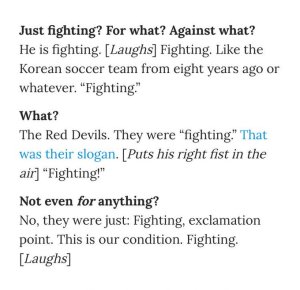
I somehow just stumbled across a years-old interview with the actor John Cho, who, like me, is of Korean ethnic background. The Korean soccer team slogan, made famous in their run in the World Cup a while back, was “Fighting!” Somehow that came up during the interview, and John Cho explained:

This is our condition. Fighting.

Every once in a while, I idly consider getting a tattoo, but it never gets very far, because I can’t think of anything I’d want permanently imprinted on my body, other than a well-placed battle scar. But now I know that if I ever go through with it, I’m going to inscribe “This is Our Condition: Fighting!”

Now, I’m not some kind of Korean studies major – I’m as far from that as I could be. I don’t speak Korean, though I’m sure if I did I’d be aware of the subtleties lost in translation into the simple term “Fighting!” I wouldn’t be surprised if those subtleties are most of what I’m trying to explain here. I don’t even remember specifically being taught any of this. And yet still, I’m writing entirely from memory, I’m not going to look up any of it. That’s why there’s no dates or numbers: my memory’s really not that good.

But I’ve always loved to fight, and I still do, even though I may not have what it takes anymore. I’ve been asked many times over the years what this is all about. For most of the time, I’ve really been unable to explain, mostly because I was too angry to explain. But for some reason, John Cho’s explanation was like a koan that opened up the doors of enlightenment as I pondered its meaning. (By the way, it’s not like I’m some sort of besotted fan. I mean, he seems plenty talented, but I haven’t really seen him in enough things. Yes, I’m aware that there’s a meme where he’s in movie posters for movies that no one will cast him in. I think I liked him in the first Harold & Kumar movie, but I never seem to finish it because I keep wandering off to grab something to eat, you know?)

So anyway, first I’ll explain “Fighting!” very quickly, then I’ll break it down. Here’s the quick version (just speed read it for now – it’s deliberately dense, we’ll come back to it later):

Yes, of course I love to fight, it’s part of my core, and there’s no foreign mystery to this at all, no false stereotype. It’s a natural outcome, as follows: my mother, burdened by PTSD and bipolar disorder, made her poor attempts to find shelter in her rigidly sexist world by instilling an absolutely indomitable ego in her only son, which ironically is exactly what the patriarchy insists upon. A child’s ego is thoroughly reinforced by its use as a shield against the relentless onslaught of physical and emotional rage from father to son, as father had inherited from his father before him, in a ruined landscape of the battlefields of actual and proxy wars among superpowers on the Korean peninsula. That sense of fighting spirit – fighting as not only necessary but tantamount to survival – it never goes away, not with age nor wisdom, so that any satiation is temporary and the fight is everlasting.

Now … that might sound like a uniquely specific and melodramatic personal story, but there’s hardly anything unusual in it for generations of Koreans. You may be vaguely aware of the history. I’ll keep the pace up through this breezy recital, since these are all things you probably heard about in bits and pieces before:

After decades of imperial rule under Japanese occupation, in which the Japanese routinely pursued policies of cultural eradication, the Koreans were briefly liberated with the Allied victory in World War II. This liberation was incomplete when the Korean War promptly broke out, greatly inflamed as a proxy war between the United States and China, with the looming specter of the Soviet Union in the background. (This actually was only the first of a series of bloody proxy wars against Communism which continued through Vietnam and much of Southeast Asia, and even today continues in the Middle East and Africa.) Korean families were divided and impoverished by war, such that it became very common to experience the early deaths of immediate family members, including an especially high proportion of children. Korea is a relatively small country for superpowers to stomp around on – the war affected everyone.

Of course, as this happened way back in the middle of the twentieth century, there was hardly any therapeutic understanding of the mental trauma involved in all of this; at least, not in the terms we would discuss for same conditions today. The prevalence of PTSD was undoubtedly very high, and bipolar disorder could be expected to be no less than it would be at any time in any other place – though with even light cases highly likely to be exacerbated by the conditions of survival in the war-torn land.

Go back up to the short version, and see if it makes more sense now.

I’m not saying that every single Korean has experience with all of the implications of the description here, nor that all Koreans would agree with all of the implications of this description. And of course some of the effects of these common events are dissipated in time as well as diaspora, although some may be intensified by the common immigrant experience of dislocation, isolation, and racism.

I’m also not even going to attempt to explain whether or not any of this is related to a progress within three generations from a country that looks like background footage in M*A*S*H to a country that makes among the best consumer electronics in the world while also producing entertainment that somehow has not only reached the heights of world mass culture, but also accrued international social media clout with actual political impact in the United States of America. I mean …

I’m just saying, I think I know what John Cho was talking about, and I just wanted to share it with you. Put him in some more goddamn movies.

ETA Jan 2023: This seems the right place to note my succinct definition of han: A deep-seated sense of injustice, which fuels a never-ending thirst for revenge.

the logic of “silence is compliance”

https://commons.wikimedia.org/wiki/File:Silence_is_compliance_-_A_protester_with_a_message_standing_on_a_window_ledge_in_Whitehall._(31903348794).jpg

“Silence is compliance” is a phrase that many people toss off without thinking through how it works. People who use the phrase earnestly think that it’s obvious that silence in the face of injustice is equivalent to complicity in that injustice. But apparently, it’s not so obvious, because many people quote the phrase with a sense of irony, as though it is some kind of slogan for Orwellian thought control.

I have never seen the logic of “silence is compliance” thoroughly explained, so I’m going to attempt that here, just for kicks. I’m sure if I looked hard enough, I’d find a reasonably similar explanation, but the logic is straightforward enough that it’s probably easier to write it from scratch than it is to find an explanation as painfully dull as the one I’m going to give here.

First off, it’s important to discern that the phrase is only really meaningful in political contexts. People do sometimes use the phrase in other decisionmaking contexts, but in those it’s usually meant as a dumb joke. Somehow that dumbness is transferred through osmosis when some people see the phrase in political contexts. For example, when someone says, “Hey how about burritos for lunch? Silence is compliance!” – it’s obvious that this means nothing more than, “If you don’t say anything, I’ll move forward!” (And when you think about it, what even is illogical about that statement?) This is a completely different kind of claim than “Speak up about injustice! Silence is compliance!”

In a political context, it’s a reasonable moral claim, and deserves to be treated as such regardless of which side of the politics you’re on. We can demonstrate exactly why with an example of a controversial political issue … Hmmmm, so many to pick from, what to do, what to do … Well, though I’m tempted to go with old statues, or Confederate flags, or kneeling at anthems, virus names and nicknames, or “violent” protests, but no – these topics may be too hot right now, they could inflame consideration of the simple logic being offered. So I’m going to have to take down the temperature to … Islam vs the West. Truly extraordinary times we are in, that this qualifies as de-escalation!

Let’s start with a controversial statement about Islam, like “Islamic culture supports honor killings.” A “progressive” reaction to this might be something like, “that’s a horribly racist stereotype that is factually untrue.” A “conservative” reaction might be “we lose everything of value if we cannot acknowledge the truth of the harm done in the name of Islam.”

For comparison’s sake, let’s also present the caricatured responses from the land of social media:

Social Justice Warrior“: Your harmful words deny our reality as a people! Until you come to terms with the racism in your soul, you will never know the truth of your injustice! You must bow down in fear to our coercive power to silence your reasonable objections to our moral superiority!

Intellectual Dark Web“: You’ve lost sight of the true meaning of liberalism, for you lack the courage to grasp the freedom that is clearly within your reach. You can never outlast the real truth that you are too weak to see. Intellect über alles!

Now, neither of these responses have anything to do with Islam or Western culture, and no one worth your attention ever says exactly these words. Nevertheless, the entire discussion proceeds in social media as if only the other side had said the words of their own caricature. It’s quite an amazing phenomenon.

Back here in the safe ol’ blogosphere, we have the space and the luxury of constructing arguments from steel rather than straw, and insisting that the only welcome comments are fires that temper the steel rather than burn the straw. Or something like that.

So, initial steelmen in this “Islam vs the West” example would be something like:

The “scholarly” view: An attentive reading of the Quran shows that honor killings are to be condemned, as an innocent life is lost and the perpetrators of this crime do not set a good example for society. Of course there are radicals; people with abhorrent beliefs and actions, but it is not fair to taint Islam with their distorted beliefs, just as it is not fair to taint all Christians with the beliefs and actions of the Crusades and many other wars and acts of genocide carried out in the name of a Christian God. It is unjust to impugn all of Islam by association with the horror of honor killings.

The “cultural” view: You can’t claim that a religion is just the words in a book. A religion is how people live it, and how it manifests in the world through the people who claim it, whatever the merits of their claim. I do absolutely condemn all of the wars and genocides of the Christian God, I do also agree that a Christian culture led to those evil outcomes, for the same reasons I cite regarding Islam. So when I say that Islamic culture supports honor killings, I am only stating a fair interpretation of facts and a cultural understanding applied equally across all cultures.

These may have weaknesses, but they are not strawmen, and they can both be much improved. It might even be possible to improve both of these positions to the point that they are not in factual conflict, while they still remain in support of their political positions – but that would be a difficult discussion. It would be lengthy, it would be nuanced, it would be challenging and at times frustrating and possibly emotionally exhausting.

The fact is, all serious political controversies have steelman arguments (including any controversy over whether I should be saying “steelwomxn” instead). But it’s much easier to burn down the strawmen than do the hard work of discussion.

And further, it could be a reasonable moral choice to decline to do the work. In general, you are not obligated to provide anyone your intellectual or emotional labor, and you don’t even need to have a reason to decline, not even privately for yourself. You only have an obligation to engage with people that you’re already in a relationship with, like your partner, or your kids, or your neighbors, or your town, or your country … hey waitaminute …

Politics, of course, is an endeavor among people living in the same society, even if some of those people wish some of the others would leave. Any belief in a political solution raises the obligation of informed discourse. Maybe you don’t have to discuss every little political issue that the neighbors want to gossip about on Nextdoor. But you most certainly do have an obligation to participate in discussions of justice in your society, because if you are willingly living in an unjust society, then one way or another, you will eventually suffer the consequences if you aren’t already.

When a political issue raises questions of injustice, understanding that you have this basic civic obligation to participate is only the first step for making silence into compliance with the injustice, but let’s be clear: you can’t skip that step. To say, “I don’t owe anybody anything!” is simply to withdraw from political participation entirely. That may be your right in some circumstances, but if the current situation is indeed unjust, and you decline to consider yourself in the society at all – when it is in fact true that you are in the society – then your objection is based on a lie, and your silence is willing compliance with injustice.

But what if you do recognize the obvious fact that you’re in the society, but you just don’t want to say your opinion because you know that other people won’t like it? In this case, you are even worse, morally speaking, than in the prior case. There is a claim of injustice in your society, and you will not speak on it because you are afraid of what others will say? How is that a defense of your silence? What if you’re wrong, and your opponents are right about the claim – don’t you want to support justice even if you’re wrong? And even worse, what if you’re right, and your opponents are wrong about this claim of injustice – wouldn’t true justice be better served if you spoke up, regardless of what anyone says in response? In this case, silence is not only compliance, it is cowardly.

And what if pure intellectual freedom favors one outcome, while the demands of social justice favor another? Again: if either of these things actually matter to your society, and you remain silent, then you are compliant regarding the claim of injustice. Ok, one last shot: What if intellectual freedom allows anyone to favor either outcome, but only one of the outcomes supports injustice? Isn’t individual freedom the highest freedom of all? “I still want to pick the outcome that supports injustice, and the inviolable freedom of my mind gives me that right!” So … you’re saying that you could choose to believe either, and you consciously chose to believe the one that favors injustice, just because … you like it better? At this point, there is only one word for you, and I’m too polite to use it, motherfucker.

These intellectual gymnastics are unnecessary. Simply note that all claims of injustice perpetrated by the state are claims that the powerful committed injustice against the powerless. So the default outcome to a true claim of injustice by the state, if nothing is done, is for the injustice to continue. If the claim is false, and you don’t speak up about it, then you are contributing to the decline of a just state. Either way, the worst thing you can do is remain silent.

My point isn’t whether any of the stereotypes, caricatures, steelmen, strawmen, or painfully obvious statements above are bulletproof. My point is only that there is a reasonable and straightforward argument for why silence is compliance, and those who only view the statement mockingly are making a careless mistake. I’m not saying that everyone who utters the phrase has exactly this logic in mind, with this kind of specificity – good people usually don’t have to think it through in that much detail, because it doesn’t occur to them that anyone doesn’t see the clear logic: silence in the face of injustice is morally equivalent to compliance with that injustice.

police technology

fingerprint

In the future, the police as we know it today will not exist.

This is not a political statement, it’s simply a technological fact. Now, it’s essential to remember that all technological facts are endlessly contingent. For example, it’s a technological fact that if you click on a link, another webpage will open. But that’s contingent, usually on some very complicated and impressive infrastructure operating without fault (or rather, with sufficient fault-tolerance whose few exceptions did not affect the expected outcome, this time).

If you click a link, it will only do what technologists expect if you’re using a browser that doesn’t have the wrong kind of malicious software. And you have to be using a computing device that doesn’t have some other hardware or software flaw that will prevent expected actions. And you have to be connected to a network that has sufficient range and capacity. And then an entirely different set of computing devices needs to be connected and operating as expected. And then all of that has to work correctly, walking backwards, in high heels. During this entire time, every device involved needs to have electric power in the right amount and at the right time. That is a lot of contingencies.

But still: if you click on a link, a webpage will open (even if it’s not the one you expected). And with just as much certainty: in the future, the job of police will not exist as we understand it today. That is a technological fact, and it requires very little understanding of technology to see that. It merely requires obvious extrapolation from technologies you see around you every day.

Most people, including most police officers, may think the job of police is to stop crime. But all police officers know that it’s more an exception than a rule that they make an arrest on any given day. This is not an indictment or a criticism in any way, it is simply a pure accounting of time. Cops probably spend 50% of any given day in travel time, going from place to place. Maybe another 20% of the day is talking to people: talking to each other, to dispatchers, to citizens with a question or complaint, to witnesses, to victims, to prosecutors and lawyers and judges and juries. Then 30% of the day is administrative: paperwork, paperwork, paperwork, court time, occasionally some training. As a proportion of time spent, there is almost no time spent on a usual day in the active act of stopping crime. Stopping crime might be the reason for police, but that’s not how they spend their time on the job.

Of course, there are occasions where crime is discovered during travel time noted above, and during the talking time above. That happens a lot more on TV than in real life. More often, crime is discovered through other means: an alarm, a call to 911, while carrying out a search warrant, perhaps during a stakeout, or a successful search for a suspect. Police action in each one of these cases is planned beforehand, it doesn’t happen extemporaneously. There is forewarning, and police are specifically sent to a location where the crime may be discovered. None of this is the result of random discovery during the usual day at work.

Technologists hate inefficiency, and can’t help but think about designing for a more efficient police force. A perfect police force would do nothing but fight crime: they would only conduct the very few activities that are a result of planned actions expecting to find crime. The other activities would be done by people who were not police: all that traveling around, talking to people, filling out paperwork – people who are not police officers can do all those things. That is not to diminish the importance of any of those things, and many of them are essential to stopping crime – they are just not themselves the active act of stopping crime that requires the most prepared police action.

In a perfect world, anyone who might ever be involved in actively stopping crime would spend all their free time preparing for the most dangerous police actions, and they would have exactly the resources they need to stop the most deadly opposition that they are likely to encounter – no more and no less. Because some crimes are so inherently dangerous, perfect police would spend all their time on training when they weren’t actively in the act of stopping crime. And in a perfect world, their training would be perfect, so they would follow the best possible tactics to avoid escalation and the use of deadly force, including the elimination of any kind of bias whatsoever.

Obviously, we do not live in a perfect world. There are many, many social reasons why we cannot today operate a perfect police force. Many. But there are also many technological reasons: we cannot predict where crime will happen, we can’t be everywhere at once, we can’t travel fast enough or efficiently enough or safely enough. We might not have the data we need to identify everything that we need in order to make good use of technology, including data relevant to both crime and to training.

The thing about technology is, though, that all of the technological problems will be solved, so long as social barriers don’t prevent that from happening. To be clear: this is NOT an argument for the moral supremacy of technology. Morality is only to be found in society, not in technology – and there may be times when the development of a certain technology may be itself immoral. However, in the absence of social barriers (including moral barriers that we should respect), technology problems will be solved, because that’s the definition of technology: applied knowledge that solves problems. If a problem can’t be solved through technology, it’s not a technology problem: it’s a physics problem.

So in the future, cops will do absolutely nothing other than attempt to stop crime, and train to do that in the best possible way – unless social barriers prevent it.

Unless social barriers prevent it, predictive technology will show where crime is likely to occur, with very high accuracy. Some people might think that there’s no social barrier that should prevent such an obviously worthy goal. Some people will be more concerned about social harms that might come from errors and bias. Some people will be equally concerned, if not more, about the surveillance required to enable predictions. And yet some others believe that citizen surveillance could be a safer alternative to state-operated surveillance – or maybe that some combination of the two, formally or informally, would work optimally. But in any case, if it becomes known that a crime may be stopped, regardless of how it might be known, the police should be sent to stop that crime. Few people could possibly disagree that this would not be what we want from a perfect police force, which don’t forget, is perfectly trained.

As for the people who do all of the other things that police do today – some might argue that these are still police officers, that they are still as essential and honorable, if not even more so. And indeed, it is irrelevant whether or not they are called by the word “police” and irrelevant whether they wear a uniform and irrelevant where their paycheck comes from, from a technology point of view. Social factors determine whether they are called “police” or social workers, whether they are public or private or nonprofit. Those kinds of things have nothing to do with technology – although technology could certainly help determine which social choice is most likely to be optimal.

Social factors also determine whether those other “police” (whether or not so named) are allowed to carry weapons of any kind. None of these people are performing any tasks that are particularly likely to discover a crime in progress, so they clearly don’t need a weapon most of the time. Crucial exception: tasks that routinely involve interactions with victims, actual or potential, will of course discover crimes in progress. But as this is discovered from a victim, no weapon is needed unless for some reason the perpetrator is nearby, as is usually the case with domestic violence. Even in this case, it is clear that the task of ensuring safety is different from the task of preventing ongoing violence, so these are obviously separate jobs, only one of which is likely to need a weapon.

Social factors determine whether or not people who spend so much time doing social work should be able to carry any particular kind of weapon. Whether a “police officer” actually needs to carry a weapon is a social question. For example: maybe a political reason requires all the people doing all this driving around, talking to people, and filling out paperwork to be called “police.” And maybe other social factors require all people that are called “police” to carry weapons that they don’t need, for example for recruiting purposes (assuming that some people join the police at least in part due to their affinity for weapons). As a counter-example: maybe for political reasons, only the people who are actually trained to stop crime will be called police, and all of the other people will be some category of social worker (whether public or private). In that case, it seems unlikely that anyone would want the social workers to carry weapons. But it’s very clear from a technology perspective that only some types of work that we call police work today requires any kind of weapon.

So, in the future, the police as we know it will not exist, as a matter of technological fact – though this is endlessly contingent on social factors. In a perfect world, most people that we call “police” today would be doing the exact same thing that they do today, in terms of time, but they wouldn’t carry guns. Any rational person wouldn’t even want them, at least not for work, as they would know that they are unlikely to ever need to use them. (This is completely independent of any 2nd Amendment argument for or against carrying guns, as those arguments apply to all citizens, not just particularly to police.)

Like all technological predictions, the inevitable end of police as we know it is highly contingent on the expected operation of an extraordinarily complex and interrelated system of infrastructure and endpoints – but this is dependence on social infrastructure and people, not technology. Nevertheless, any good technologist should understand all relevant contingencies.

It’s very easy to imagine an attempt to reach this perfect world that inadvertently turns into a totalitarian police state enabled by technology – we’ve all seen those movies and shows many times now. It’s very tempting to imagine that enough social problems can be addressed so that technology has the social basis it needs to be successful – but there isn’t really much data that should give anyone optimism. So good technologists should spend most of their time finding data and implementing solutions that address the social infrastructure that is required for success.

I didn’t intend to include any moral suasion in this very dry essay, but I can’t help but end with it. Technologists: stop building weapons (anything that enables the police state), and do the social work (data and tools to solve the social problems that prevent us from working on more useful technology).

ETA: Someone suggested the perfect slogan for techies who want to reboot the police: CTRL-ALT-POLICE.