what is technology?

Since the 2008 financial crisis, the world economy has been in the doldrums, and every time we think we’re out of the storm, we find that we are still at sea, struggling to stay afloat. Europe appears on the verge of disastrous devolution, and the world economy as a whole is roughly at the same levels as 2000. Will we ever feel confident that we are returning to sustainable growth?

I think the answer lies in technology investing. I think we just have to ask, Have we been investing in technology? But in order to answer that, we have to know what “technology” is.

Ask a random stranger “What is technology?” and you’ll likely hear something about “computers” or “the Internet.” Most people assume that investing in anything having to do with computers or the Internet is automatically “technology investing.”

This can’t be right, of course. The term “technology” has been around since the 1600s, before anything like today’s computers existed. I suppose a compass was considered technology back then, and when the sextant was invented it was “high-tech.” More recently, though still generations ago, the technologies of railroad transformed the world economy from the mid-1800s, and automobiles shortly afterwards extended that transformation further into our economy and culture. Broadcast radio and then television and movies became important technologies as mass media came into our lives from the early-to-mid 20th century. The cycles got shorter and faster with computers in the ’70s and ’80s, and the Internet from the ’90s.

When we say “technology” today we no longer think of trains or cars or even radio or TV. All of those things still have technology in them, but none of them represents what we mean by “technology.” So it only makes sense that someday soon “technology” will bring no reflexive association with computers or the Internet. So what then will it mean when we say “technology”?

My nutshell roadmap of technology from the compass to the Internet stopped in the 1990s. The right investments in seafaring, shipping, autos, broadcast networks, computers and Internet resulted in personal fortunes and worldwide economic growth. I think in any of those eras, you could ask “Are we investing in technology?” and the answer would be a clear yes, and you would have been able to point clearly to the technology. But ask yourself today, “Over the last decade, have we been investing in technology?” and I’m not comfortable with the answer.

“Technology investors” have made personal fortunes and huge companies have been birthed since 2002, but what is the technology? Should social media and games be considered technology? Should mobile phones and tablet computers? If so (or if not), why (not)? What is the definition? What is the test? What is technology?

Here is the simplest definition of technology:

Technology promises a better life.

This begs a question with almost every word. Why a promise? Better by what standard? Whose life? Before trying to clarify, let me propose a test:

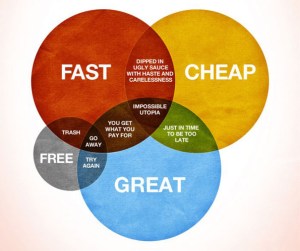
Technology delivers what you need while breaking the boundaries of the Speed/Quality/Price triangle.

When technology works, you get what you need at a higher quality, lower price and faster than you could have gotten it before. At introduction, “high-tech” may not include all three right away, but it’s apparent even early on that the speed, quality and price will inevitably improve. This is why technology is a promise – early iterations may give you what you want with clear improvement in only one of the three aspects, but even early on there is an explicit assumption that the other two will follow. It’s also inherently assumed that although only an exclusive few might access and benefit from the early technology, someday everyone will. The definition of “better” is just that “quality” is delivered, in whatever definition of quality that is being used at the time, but that the quality comes faster and cheaper. So: Technology promises a better life.

How well does this definition and test fit the waves of important technology advances of the past? If say, the prime years of your life were from 1930 to 1970, did television give you what you needed, better and faster and cheaper? At a time when we went from worldwide depression, then broad scale war, then peace and increasing interdependency and complexity and societal change – yes, I’d say that the ability to viscerally and quickly deliver news, entertainment and culture gave life what we needed. How about the personal computer, the Internet, and search engines? I think positive answers are similarly easy to construct, and negative answers are mostly dyspeptic dystopianism.

Now how about social media? Well, everyone needs friends. Everyone needs a way to connect with friends, close and distant. Everyone needs to be a part of a community. But are social networking companies truly satisfying these needs? Is that even what they are trying to give us? Do your multiple social networks, hundreds or thousands of “friends” you have on them, their messages and status updates and pictures and quotes of the day – are these giving you what you need? Is this a promise of a better life for you?

I have no problem if your answer is “yes” to these questions. But I can’t answer yes, and I fear that most people wouldn’t answer yes, and this makes me uncomfortable because when I return to the question, Have we been investing in technology over the past decade? – I also cannot answer yes. And that means I cannot see how we will emerge from this worldwide economic slump.

I’m sure there is active investment in technology that really does promise a better life, but that’s not the mainstream of what’s called technology investing today. When autos and radios and TV and computers and the Internet were coming up, there was plenty of investment fervor around these industries. Today, the fervor is around companies that promise all sorts of interesting things, but I wouldn’t call most of these things a promise of a better life. They may be great companies, they are certainly filled with great people, they definitely have smart investors – but they are not making technology. And if we fail to invest in technology – real technology – then the economy will not return to robust health, and life will not get better.

full belly

p. 75:

Then he went out on the sidewalk and they shot him three times in his full belly and drove away.

Meyer Wolfshiem compact tale of his friend’s execution takes less than a page. The words Fitzgerald puts in his mouth are creatively efficient. For example, instead of describing the restaurant’s windows as darkened against the slowly rising sun, he says ‘if we’d of raised the blinds we’d of seen daylight‘ – conveying not only that the hour was so late that it was early, but that they’d had the blinds down all through the feast.

It wasn’t enough to say that Rosy was shot in the stomach – he was shot in a full belly, a belly full of the repast shared through a long evening with friends who knew their time together would end, and probably not pleasantly. I like the way this small detail reinforces the extended pleasures of the night even as it marks the fatal delivery of the executioners’ bullets.

great trailer

Let me count the ways I’m excited about this trailer for the upcoming movie adaptation of The Great Gatsby:

  1. Baz Luhrmann – he’s renown for fearless interpretations of classics like Romeo + Juliet and La Bohème. The 1974 Gatsby film was a stultifying period piece – that kind of boredom just isn’t possible in Baz’s world; he is always more faithful to the emotion than the period.
  2. Carey Mulligan – she’s proving to be one of the great actresses of her generation. From the brief bits in the trailer, it looks like all of the actors have really absorbed the book (though I’m a bit worried about Elizabeth Debicki’s screamy Jordan Baker), but Mulligan stands out as a true embodiment of Daisy. Her line delivery of “You always look so cool” says exactly what that line is supposed to say.
  3. Jack White’s cover of Love is Blindness – U2’s Achtung Baby might be my favorite album about love and relationships (well, that or Tunnel of Love), and Jack White’s searing cover is a perfect backdrop to this fevered trailer.

The release date of Christmas 2012 gives me something to aim for, as a date to finish the Gatsby Project.

Update: The movie’s release date has been moved to May 10, 2013.

across the street

p. 74:

This is a nice restaurant here … But I like across the street better!

Nick and Gatsby meet Meyer Wolfshiem for lunch in an elegant restaurant in midtown Manhattan. It’s the kind of place where the headwaiter knows to install a highball in your hand before delivering a succulent meal to your table. But Mr. Wolfshiem prefers the place across the street, an under-ventilated, cramped little joint where he’d spent many nights drinking and eating with his old friends, right up until the night that one of them was called away from the table only to be shot to death in front of the restaurant.

Why does nostalgia so often attach itself to horrible moments? All things pass, all things must end, and this includes the best and the worst that life has to offer. We never want the good times to end, and the better they are in the moment, the more we might build them and cherish them and protect them – but these times will end anyway, for time and fate are relentless and heartless. So the end is necessarily abrupt and painful, no matter how long it was in coming or inevitable it may have been. And yet, the end is part and parcel of the intensity of the joyful moments, inextricably linked to the electric vitality of the good times. To remember the end is to pay tribute to the entire journey.

And that’s how it’s possible for Mr. Wolfshiem to look fondly back on the night his friend Rosy Rosenthal was executed after dinner at his favorite restaurant.

steal this book

Steal This Book by Abbie HoffmanWhy don’t people steal books?

I mean, I’m sure people do steal books, but it doesn’t seem to happen in any extraordinary volume, as compared to, say, music. It’s not unusual to know someone who has downloaded a copyrighted music file without paying for it (aka “stealing”) – you might have even done it yourself, no? – but do you know a single person who has ever downloaded a copyrighted book without paying for it?

The music industry has been famously apoplectic for years about the problem of illegal music file sharing. The movie industry watched the music guys disintegrate, and is aggressively riding the Big Hollywood effort to stop the evil Internet so that what happened to music doesn’t happen to movies.

Now the book industry is also undergoing seismic shifts due to new technology, but this begs the question: why didn’t books, the older and easier medium to steal, come first – why doesn’t anyone steal books?

Is it the medium?

Smaller things are usually easier to steal, and this goes for the digital world as well as the physical world. Constraints on bandwidth, storage and processing power are one reason that music files are more broadly shared or stolen than movie files – a typical movie file is well over 100 times larger than a typical music file. But a book file can easily be less than a tenth the size of a file for a 3-minute song, so again, it seems strange that these little book files don’t get the five finger discount.

Maybe music and movies are different because they require electronics to play a recording. As electronics have gone from analog tape recordings to digital media files, music and movies got swept up in waves of theft because those files played on devices that could be connected to a vast file sharing network. Meanwhile, books did not have a common electronic reading device until the Kindle and Nook.

I’m not sure I buy this narrative – recordings of audiobooks have been around for just as long as music files – do you know anyone who has ever stolen an audiobook? Now that the Kindle and Nook have been around for a while, have you ever heard of anyone using these devices to read troves of stolen books?

Is it possible that the difference is not in the technological trappings of the media, but in its emotional impact? Do music and movies move something in the soul that causes people to steal, because the enjoyment of the media is so irresistible? I doubt it, because there are emotionally gripping books as well as dull songs – I don’t think there’s a category of books that get stolen more often than others, other than the category where the title is a command to steal.

Maybe the reverse is true – perhaps movies and especially music are trivial fluff, not valuable enough to fear stealing, while books are weighty, too precious to steal. Price may provide a clue here: a hit song is now around a dollar, a movie around ten dollars, and a new digital book is ten to fifteen dollars. Perhaps the market is validating the theory that books are more valuable, more emotionally compelling, and therefore harder to steal casually. But I doubt this too – there are a lot of crap books out there, and you can learn more from a three-minute record baby than you ever did in school.

Is it the audience?

Maybe the people who enjoy books are different from the people who enjoy music and movies; or at least, they’re different when they’re enjoying books, even if they’re the same people.

Viewing unauthorized download of copyrighted files as “theft” or “stealing” requires a certain conception of a moral universe. Many books, especially novels, convey some sense of moral order, or even when conveying moral disorder the implicit contrast to a typical moral universe always exists. Maybe the people who enjoy reading books are people who believe in a particular kind of moral universe, one in which unauthorized downloading of copyrighted material is rightfully considered stealing. In short, maybe book lovers are better people, and don’t steal. Presumably under this theory, music lovers are dirty techno-hippies with no sense of right and wrong.

Or … maybe book lovers are just weird. The urge to possess books as a physical object is common enough that even obsessive collection is considered only a gentle madness. Possibly the act of stealing a digital file is simply unsatisfactory, as it doesn’t sate this need to possess the object – shoplifting a file just isn’t the same. While music lovers do have some notable examples of vinyl obsessives, this doesn’t seem as common as the book geekery is among bookworms.

Is it possible that book lovers simply have more to lose, being a smaller and almost by definition more educated (i.e. literate) class of people? Maybe music and movie lovers that are of the same social and economic class as book lovers actually steal music and movies just as infrequently as book lovers steal books?

Is it the industry?

The music industry was famously hostile and arguably stupid in its stance to file sharing, and Big Hollywood seems determined to replicate that stance regarding all the evils of the Internet. In contrast, the book industry seems scared, but oddly accepting of its fate, almost savoring the last days of their bygone ways, lounging on the beach languorously watching the tsunami roll in.

Or maybe the book industry is simply smaller than the music and movie industries, and so hasn’t spent the time and money to raise the hullabaloo that other media industries have raised. And being a smaller industry, maybe it’s simply more accepting of change.

Is it possible that the book industry isn’t in utter panic because they’re aware of the history of media cries of wolf, howls of inevitable doom that accompany each technological change, each of which result in more money and more opportunity? Maybe book publishers are relatively sanguine in the knowledge that they’re making higher profits than before the Internet ruined their industry.

This is all just semi-coherent rambling, but it’s a ramble that’s been rattling around my skull for a while now. I don’t really have a clue why people don’t steal books, or at least don’t seem to steal books in comparison to music and movies. I’m hoping one of the handful of readers who stumble across this post can point me to a better answer.
too early in the game

Last month, I wrote about why Second Life failed so I didn’t have to write about why Second Life failed. I mean, that post wasn’t about reasons for failure, it was about the fact of failure. My thought was that there are many people who simply assume Second Life failed, and they’re wrong, and there are many who will passionately argue that Second Life has succeeded … and they’re wrong too. Failure can only be judged by the ones who were trying to succeed.

It would be safer for me to say that failure is a matter of perspective, for surely failure passes through the same lens as beauty in the eye of the beholder. I do understand that many SL Residents were on their own journeys, and so of course they are their own best judges of the success of those journeys. But it would be an artful evasion to claim that any of those journeys, or even all of them together, constitute the sum total equation for the success of Second Life. We were trying to do something more – or at least, something else – and we failed. (Of course, I’m talking about the team and the company that I knew, years ago. The team there today is on their own journey, which I know next to nothing about.)

So if I’m willing to be this myopic and insular about judging failure, you can bet I’d be just as parochial in reviewing the reasons. I’ve seen and heard a lot of speculation that I don’t agree with: poor strategy, worse execution; lack of focus, misplaced focus; poor technology, doomed architecture; dumb marketing, uncontrollable PR; niche market, bizarre customers; crazy culture, undisciplined development; bad hiring, bad management; feckless board, dominating board, ignorant board. I’ve heard it all, and while there may be a grain of something like truth here and there, none of these things holds real explanatory power as a reason for why Second Life failed.

We failed as people. We failed as a team. Our failure was intensely personal, particular to each person involved, and ruinous to the overall team.

I’m going to switch now from “we” to “I” but I want to be really clear about why. We Lindens were all in it together, and there is a broad sense in which all credit and blame goes to all of us … but not in this post. Here, I’m talking about maybe half a dozen people, and so it would be too much of a personal attack for me to try to describe the failures of anyone other than myself. I’m willing to attack myself in this forum, but not my former colleagues, all of whom I still respect and a few of whom I love like my own family. But I want you to remember the “we” because otherwise the rest of this post is going to seem incredibly egocentric: there’s a certain kind of self-blame that’s really self-aggrandizement, and though I regard my own failures as critical, even the most deluded version of the story couldn’t claim it was all about me.

So. I failed as a person. I failed the team. I was responsible for many elements of our strategy, execution, culture and management, and those decisions aren’t the ones I regret. What I regret, to the extent that I’m capable of regretting such a rich learning experience for me, is giving up. I don’t mean at the end, when I was tired and disillusioned and looking around at a company I didn’t recognize and a future I didn’t want to live. A lot earlier than that, I gave up on people that we needed, people who were flawed and fragile but necessary. I let people fail, I let people go, I let people hide in their illusions and fears, I let them give up because I’d already given up.

The irony was, when I joined the company, I was supposed to be an experienced hand that would bring some sanity to a crazy world. But I indulged my own worst instincts – throughout the craziest times, when I could’ve done the most good, I just brought more crazy. I was having fun, but I chose my own twisted growth over a higher goal, and at times I was just plain mean or selfish or drunk. I really wasn’t ready for the opportunity that Linden Lab presented to me. I really wasn’t the guy I should’ve been when I got there; I didn’t know what I needed to know until I left.

Too many of the key leaders at the Lab were working through similarly damaging personal limitations. You might ask whether this really points to a failure in culture or hiring or leadership, and that would be a fair question. It’s true that Linden had a way of hiring certain kinds of people and forcing them to confront their own deepest flaws – but I think that’s beautiful, a feature not a bug. What we needed was one or more or all of us to conquer our flaws, to enable the entire team to rise above the limitations of each of us. But none of us defeated our own demons, and so all of us perished.

I’ve been gone from Linden Lab for over two and a half years, and still my failure haunts me. The last day of the year is always a good moment to come to terms with the passage of time, and this New Year’s Eve I’ve decided I should finally accept the fact that I’m never going to let it go. I’ll try to reach peace through the zen realization that peace is unattainable.

anything can happen

p. 73:

‘Anything can happen now that we’ve slid over this bridge,’ I thought; ‘anything at all ….’

Race plays no significant role in The Great Gatsby, unless you adopt the ludicrous assertion that Gatsby was black. Here is the only page with a meaningful composition involving black characters. Nick sees three black passengers in a limousine with a white chauffeur, and this observation is enough to inspire wonderment at the limitless possibilities beyond the border into New York City.

Fitzgerald was only three generations removed from the Civil War, so the upheaval in the social order that he saw in the roles of the limousine riders is understandable. But there’s something he considered more improbable than that: ‘Even Gatsby could happen, without any particular wonder.’ What was so fantastic about Gatsby that we should compare his existence to the reversal of centuries of slavery?

Gatsby was a bootlegger, a scammer, a fixer, a criminal through and through. And yet he was a successful social climber, welcomed in high society and regarded as mysterious rather than despicable. But this deception isn’t enough to rate the idea of Gatsby as improbable.

What’s improbable is Gatsby’s desire, particularly his desire in juxtaposition to his contemptible reality. His dream of lost love is a desire for purity and innocence that he’ll never have – not because the time has passed, but because of the person he is. He is a criminal and no matter how wealthy or charming or famous he may become, in his actions and in his heart, he is an evildoer.

It may be that every bad man desires to have some part of his life that is unsullied by his participation – the robber who gives to the poor, the gangster that supports the neighborhood, the vigilante that protects the weak. But no action ever redeems the sinner who can’t reform his own twisted soul. Gatsby’s problem wasn’t that he couldn’t repeat the past, but that he wouldn’t have done anything differently even if he could. The idea that you can be bad and join your rotting heart to something good is the most improbable conceit of all.

why second life failed

This post is about why Second Life failed – but not in the sense of, “here are the reasons why Second Life failed,” but instead, “here is why it is true that Second Life failed.”

Slate published an article titled “Why Second Life Failed” that also, like this post, is not an elucidation of reasons why SL failed – but unlike this post, it is not an authentic attempt to support the proposition that SL indeed failed. It is simply an effort to market a new book by posting an article with a catchy headline. There is an unavoidable paradox in that any marketable headline with the structure “Why [X] Failed” must use for X something that has first achieved at least some significant success, otherwise the title would be too obscure to attract readers. I started a company called Bynamite that folded after less than two years – no one writes articles titled “Why Bynamite Failed” because no one’s ever heard of Bynamite.

This mild paradox isn’t sufficient defense for SL’s ardent users and thoughtful critics. As is often the case with posts about SL’s demise, the comments to the Slate article are full of well-informed, intelligent and passionate conversation that puts the original article to shame. At Terra Nova, Greg Lastowka suggests that SL remains fertile ground for study, with the pointed rejoinder that “Second Life never failed – the media reporting on Second Life failed.”

As a former Linden, I appreciate the desire to insist that Second Life hasn’t failed. I joined Linden Lab in 2005, at a time when we had a few dozen employees and registered users in the tens of thousands. By the time I left four years later, we had around 7 times the number of employees, several hundred times as many users, and almost a hundred times the revenue. It certainly felt like success to me. I left sated with a feeling of accomplishment, and great hope for the future of Second Life.

But I also left feeling depleted. We had stumbled our way from obscurity to something like prominence, but I didn’t know how to take it to the next level. We weren’t making progress despite having bountiful talent, desire and resources. We had a beautiful company, a real culture of beauty and love, genuine emotion for each other and for the world we were helping to build. And it wasn’t working, not well enough and not fast enough and not big enough.

Perhaps there never was a next level. Perhaps it was always the destiny of Second Life to be an innovative niche product for a select group of people, a worthy subject of serious study, a constantly evolving emporium of edge cases. Maybe we should have just hunkered down, and focused on maintaining an elaborate playground for only a select audience of passionate and creative people. We could eke out a fine living, and damn the rest of the world who just didn’t get it.

But I couldn’t damn the rest of the world, because dammit, I’m from that rest of the world. I was never a true Resident of Second Life; I was a visitor, an outsider with the good fortune to see the incredible things that people can do in a truly free environment. I was inspired, amazed and delighted by Second Life – as well as occasionally revolted, offended and demoralized – and the diversity and depth of this experience was a revelation to me, one that I believed that everyone can appreciate.

And I still believe that, which is why I have to accept that Second Life has failed (so far, we must always say so far). The reality is that Second Life is still a niche product, and to deny that I wanted it to be something more would dishonor the heartbreaking glory of our ambition. It’s fair to say that Facebook became our second life, but it’s also shortsighted. Not so long ago, people laughed at the proposition that anyone wanted to maintain a virtual presence online that could form the basis of social interaction. Facebook did put an end to the dismissive chuckles on that topic.

But it’s equally laughable to say that this is where we’ll stop, that the final destination of online interaction consists of wall posts and text messages in two dimensions. I still believe that there’s no sensible way to define an impassible boundary between where we are today and a time when people “live” in a three-dimensional virtual environment. I’m still a true believer, an old true Linden in that way. So I have to admit that Second Life has failed.

So far.

great jobs

The death of Steve Jobs raises and answers the question that haunts the psyches of ambitious entrepreneurs everywhere: “Was it worth it?”

Praise follows death like the glowing debris that trails a comet, and the writing in the sky says that Jobs was the greatest CEO ever. A few muted voices remember that he was famously harsh to work with, but this is universally regarded as an entirely justified mania for perfection. Considering his accomplishments, it seems almost irrelevant that he denied the obligations of paternity for one child, and consciously decided that his children should know him through biography rather than time spent with him, even – or especially – in the final stretch towards death, when the remaining time must be remorselessly allotted like oxygen in a sealed room.

This isn’t criticism of a great man. It’s a reminder that many of us would willingly make the same choices, were such greatness within our reach.

We say it’s not so, and try to believe it. We encourage each other to remember family, remember health, remember that a life of striving includes the quest to achieve a full and humane life through our work. But the life of Jobs is the story of his jobs, of his one true job: making a dent in the universe through the creation of products that become a part of our lives. For his success in that, we forgive and excuse his personality defects. We cannot blame a man for failing to uphold principles that we would throw aside ourselves if only we could be assured that the universe was malleable to our touch.

Saying that “you are not your job” is a comfort; it alleviates the cognitive dissonance between your self-image and the productive economic output you contribute to the world. The lessons of Steve Jobs deny that comfort; his strongest exhortations insist that you are all about the things you make for the world – not for yourself, not for your hobbies or leisure, not even for your family and certainly not your friends if you have any. You have to do great work, never settle, remember that each day could be your last, don’t waste time living someone else’s life.

There is no obligation to community, family or friendship in these words – though strangely, there is an overwhelming commitment to society in the desire to dent the universe, for this is not a universe of cold cosmological phenomena, it’s a universe of people, and his ambition is all about changing how people live. For Jobs, if this ambition involved sacrifices of a more universal personal nature, there is no question that it was worth it. It was worth it for him, and his efforts were certainly worth it for us.

It’s touching to see the determination with which Jobs’ sayings are repeated in the wake of his death. But the message of his most appealing words isn’t quite the message of his life. He told us to follow our hearts, to trust our intuitions, to ask ourselves if our plan for this day is how we’d want to spend our last. But those are not goals, they are only beautiful means to an uncompromising end. The goal of Jobs was to be insanely great in a world-changing way. That’s the hard part of the message to understand. All of us can hope to understand what is in our own hearts, and can hope to have the courage to follow it. Almost no one alive has a realistic ambition to change the world – what many of us think of as world changing is merely interesting, hopefully entertaining, and possibly enriching.

worlds collide

You’re not a writer if you’re not writing something today about that day 10 years ago …

My wife was screaming about something on TV, but I couldn’t get out of bed. My head was heavy with flu, the sounds couldn’t penetrate the haze of mucus and sick. We had moved to San Francisco from New York two and a half years ago. I still missed The City, still missed the feeling of living in the giant beating heart of the world, a heart that pounded with the rhythm of my own. I grew up in a Jersey suburb 45 minutes from the Holland Tunnel. One of the few reliable moments of magic in my youth was the anticipation of a trip to NYC, which peaked the moment the towers came into view around a bend in the turnpike. The towers were monumental, elemental, permanent – I could no more imagine the city without them than the sky without the sun.

But a plane had just crashed into one of them. Surely an accident, I’ll read about it tomorrow when I’m over this flu. My wife is still yelling, and I bury my head deeper into the pillow and ignore the looming reality. And then the second plane into the second tower. Now even my virus-addled mind has enough strength to put together the picture, or maybe, isn’t strong enough to construct an alternate interpretation. It’s not an accident. The towers are coming down, the world is ending. I finally roll out of bed with just enough momentum to come to rest in front of the TV, where I sit slackjawed for the next two days, watching the grim images pile up, the towers falling, bodies falling, people running, debris and dust and ineffable dismay, the pictures and posters of the lost.

A call from the office asks when I’m coming in, gentle but insistent. I don’t know, it doesn’t matter, I’d already decided I couldn’t do this work anymore, before that day. And now, these people, they couldn’t understand, with their happy California sunshine and bleeding optimism. They couldn’t understand what it meant to turn a corner of anticipation and be greeted only by empty sky. I wanted nothing of them. I wanted to go back, back home, back East. Now that trip could seem like a run to a ravaged home rather than a run from a broken promise.

But that was a problem; the excuse was too easy and at the same time, insurmountable. I could tell myself that I was going home to help, but no one could look at that smouldering hole in the earth and believe in selfish lies. I wasn’t running to help, I was running away, away from expectations, dissatisfactions, disappointments. The loss of September 11 deserved better than to serve as easy explanation.

Four months later, I had quit the firm but hadn’t left the Bay Area. My life had become unmoored from a certain stable career path, into a meandering decade of exploration and discovery, of triumph and loss and the subtle closeness of the two, of searching for monuments to fill the hole in the sky.